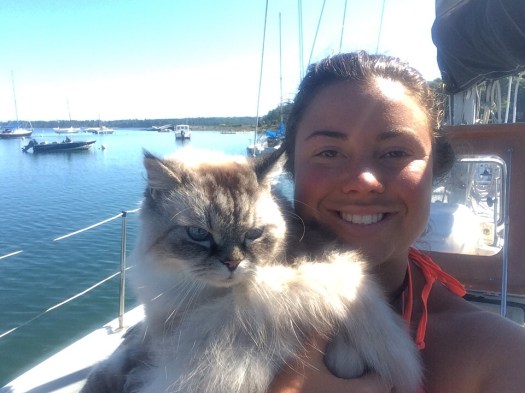
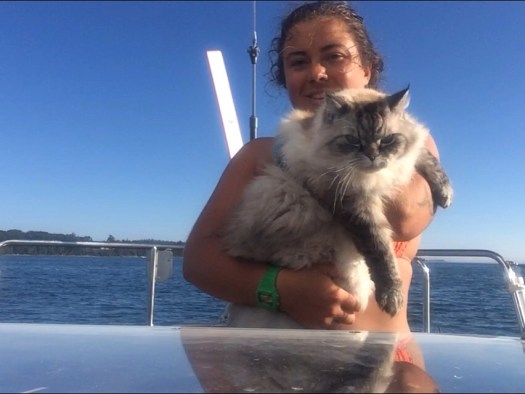
When I first purchased Gecko in May of 2017, she was set up as a weekend sailer. Even though she’s only twenty-seven feet, I was able to comfortably sleep seven people. The galley was perfect for storing booze, snacks, and plastic cups. The storage was minimal, and the cushions were plaid horsehair; in short, I had purchased a floating hunting lodge. Regardless, I had a great summer cruising around Maine and starting my fathoms-long list of changes and improvements.
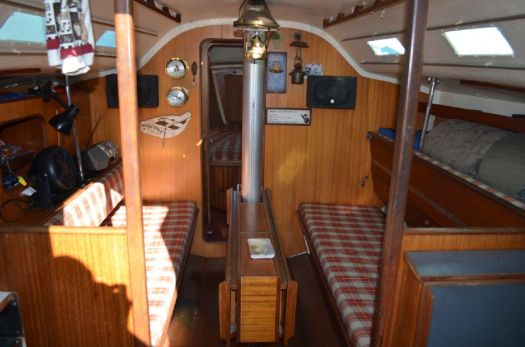
Gecko the way she looked when I purchased her as “Seamark”
I hauled out in October of 2017 and started on my first project: rip out and rebuild the galley, convert the pilot berth into lockers, change the drawers into lockers with doors, and redo the head storage area. I figured it was smart to start with something unambitious and easily manageable.
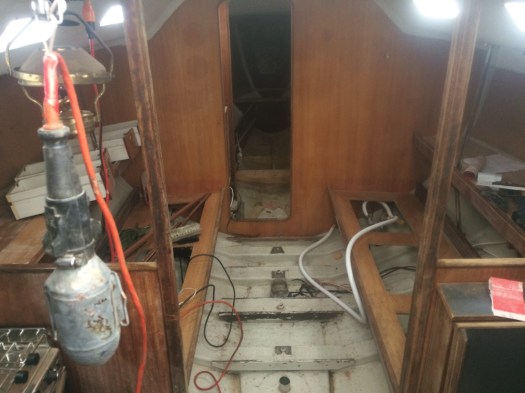
The most torn apart Gecko ever was. At this junction there was no plumbing, electrical, and all the main cabin lockers were torn out
I started by replicating the port side lockers into the space that was formerly the pilot berth. Once I had completed this, I took out the sink in the head, redid the counter top, and pulled the locker face forward by about eight inches to create more storage. Although I liked the idea of saving time by washing my hands while I was using the head, I felt like I could handle the twelve-foot trek to the galley sink.
Gecko’s original galley when I purchased her
I ripped out the entire galley and purchased a two-burner gimballed stove with an oven to install in lieu of the Princess two-burner stovetop. I started designing my new galley by putting all my kitchen supplies into the empty space and building cardboard partitions around my kitchen-ware. I find it much easier to build into the three dimensional space, rather than trying to draw it out on a 2D piece of paper.
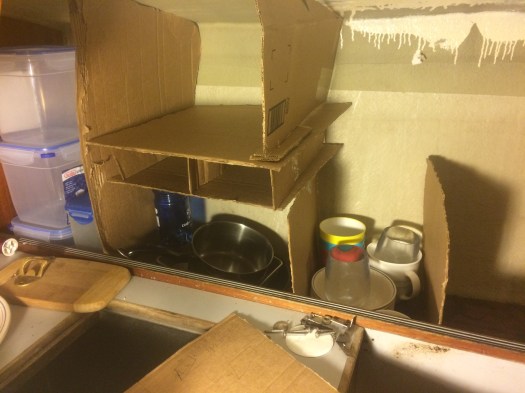
Early cardboard mock-up for my galley lockers area behind the stove
Once I was satisfied with cardboard palace, I created templates and started cutting out plywood and building my lockers. Therefore, my locker that holds pots and pans is the width of my widest pan, the plates fit perfectly into the plate area, and I can never buy any new kitchenware ever again or I’ll have to rip out all the wood and rebuild.
The dry-fit galley lockers. And new stove!
I also put in a new sink, a fresh and a salt water pump, and installed a new counter-top.
My completed galley
After I’d created all the shelves and bulkheads around the boat, I cut out locker faces and doors. Instead of using finger catches to hold the doors closed, I carved little tabs out of teak for each door. This is a locking system my dad came up with on his first boat, and it is an elegant and inexpensive solution for motivated fools with a chisel and spare day or two.
Same view, different boat! (This was pre-launch, so minus the mast)
I replaced all the port lights with lexan that I cut and routered into shape. I’m not sure what brand of ’till-death-we-part adhesive was used to seal in the original port lights (probably 5200), but it took about half an hour with a hammer and chisel to get each one out. They came out in splintered pieces.
Replacing the port lights was a tedious job. Here I was celebrating my last day with giant holes all over my cabintop
Rebuilding the interior was the first project I started, and it was ongoing throughout my other renovations. After several months in, I went back over the very first locker I built, and was able to see how far my skills had come (not as impressive as it sounds since I was starting somewhere after macaroni necklace but before mud fort). Underneath the counter-tops, I wrote messages to myself like little hidden talismans in the heart of my boat.

We left Punta Arenas on October 4th to cross the Drake Passage that lies between Cape Horn and the Western Antarctic peninsula. This journey typically takes us about four days, depending on weather. On the afternoon of day one, we were met with 50 knot winds hitting us on the beam, and 25 foot seas on the nose. For reference, the top of the crane in the video below is about 25 feet above sea level and the containers on deck are about ten feet high.
We had waves breaking onto the back deck, and with each new trough, the whole boat would shudder as it took the force of thousands of pounds of white water slamming against the hull.
After about 24 hours, the winds dropped and the seas laid down. On day four, we encountered pancake ice, rising and falling with the swell. This was the first sign that we were nearing Antarctica!
Ice and fog in front of the glacier skirted mountains
On the evening of day four, we got our first glimpses of the mountain ranges and glaciers that make up the Neumayer Channel that we transit through to get to Palmer Station.
Our first views of the scenery
At last, on the afternoon of day five, we tied up at station. Today we are doing cargo ops- delivering fresh fruits and vegetables, as well as lab chemicals, containers of break bulk, and various other supplies. We will remain on station for seven days, before we head back into the notorious Drake Passage.
This week, I installed a furry new little co-pilot.
Shackleton on his princely cockpit throne
Shack took to boat life right away, and claimed the quarterberth as his new domain. I’m only looking after him for a few days, but I considered it a trial run for potentially having my own little nugget.
The cutest boy Gecko has hosted (Sorry humans)
I have been toying with the idea of getting a boat pet for awhile, but having Shackleton has made me realise that it’s not something I’m ready for yet. Not only does it add an extra layer to clearing-in to new countries, but it’s a responsibility that I don’t want to have to think about at this point in time.
Shack singlehandedly taught me how to use my new Monitor windvane
We had a great holiday together, and he was the best little plus one on my last days aboard before I head down to work. I’ll be gone until the end of October, so stand by for pictures of Chile, icebreakers, and Antarctica!
After eight months of overhauling, my boat is ready to cruise the world!
Last May I bought a 27′ Grinde double-ender sloop. I sailed her all summer to get a feel for the changes I wanted to make, and hauled in October. Over the course of the winter I rewired, added new water tanks and re-plumbed everything, stripped out the entire galley and rebuilt it, painted, replaced all the portlights, added a set of spreaders and replaced all standing and running rigging, cut new foam and sewed new cushion covers, and countless other smaller tasks.
My plan is to circumnavigate; Gecko is in Maine right now and I’ll leave to sail south around the end of October. I work as a marine technician on icebreakers in the Antarctic and am usually deployed for at least four or five months out of the year. Between deployments, I’ve been working on my boat to get her bluewater ready.
I go back to work for 6 weeks starting September 18th. When I get back at the end of October, I plan on solo sailing from Maine to North Carolina in one long passage. Until then, I’m exploring around the coast of Maine and tuning up my new rig.